
In this blog, I wander over a few dimensions of AI and aim to address an underlying cause of why there is so much angst about its emergence. I end with my ultimately optimistic view point and encourage the exploration of what it means to be human.
With OpenAi and Anthropic needing to go public in the next couple of months, I am wondering if we are falling for the biggest sleight-of-hand in history? Sure AI can make my blog posts sound slicker*, can design an app in minutes, and probably strip out nearly all the bureaucracy of governments and organisations – but does it really make the world a better place? No doubt, it is going to change things, probably in significant ways. Yet while the home computer changed the face of work, it certainly didn’t give us those extra few days of leisure time we thought it would… Why would this be any different?
And while the hype is making it hard to know what is happening all around us, something else is stirring our discomfort – the fragility of our identity.
Many people are worried about losing their jobs. That is happening. Alongside that, we are worried about losing our futures; our certainties. But what scares us most is that we are starting to feel inferior in a way we have never before encountered.
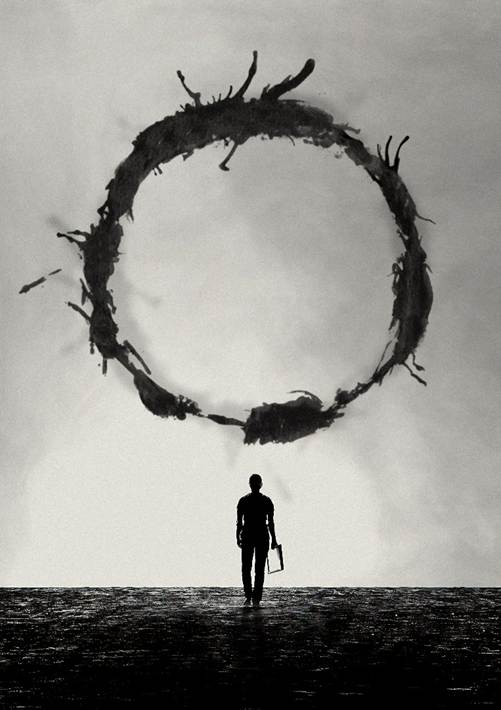
As Google’s Gemini solves yet another mathematical equation and new drugs are being formulated, our place at the top of the intellectual pyramid of life is now under threat. This is terrifying. It even challenges the Christian Tenet of being stewards of the Earth – what if something can now do that better than us?? It’s as if an alien species has come to land, and we know we have been out-played. As David Bowie put it,
There’s a starman waitin’ in the sky
He’d like to come and meet us
But he thinks he’d blow our minds
We are left wondering – what am I to do with my brain? The very thing that has differentiated us from the beasts, our cognitive prowess, threatens to grow more inadequate each day. We are not just worried about losing our jobs – we are worried about losing our place in the universe (or at least here on earth…). This feels like an existential threat. It’s more than losing our jobs (I’m optimistic, we will find a way.) And its not because we are going to be killed by AI, though many pundits fear that. No, the thing we are most worried about losing is our god-like place at the top of the intelligence hierarchy here on planet earth. And if we don’t have that, what are we here for?
Unfortunately, this leads me back to the answer that Ruth Porat, President of Alphabet, controversially suggested this month: Philosophy. As we potentially fall from the top of the pyramid into an existential crisis of an increasingly homogenised world of AI techbro language: What is it to be human? What is consciousness? And, to be with the latest zeitgeist, “How, if at all, will AI make the world a better place?”
How else are we to answer these questions without deep enquiry into the nature of ourselves?
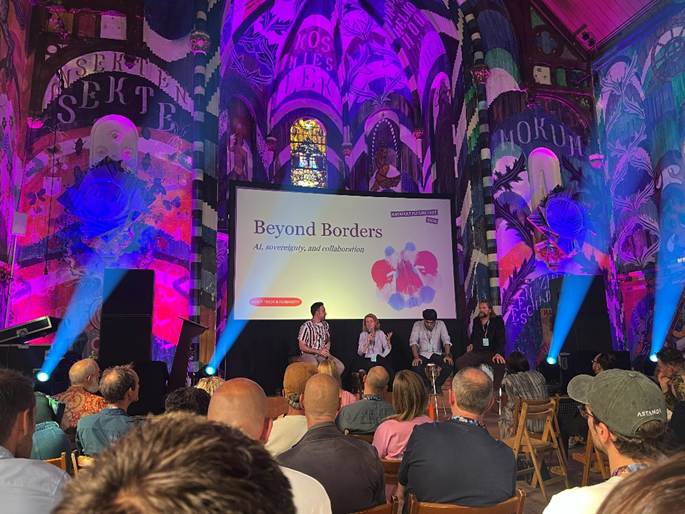
That’s what some of us were trying to do last week in Ruigoord at the Katapult Future Festival. An event that attempts to inspire wealth-holders to part with their cash in exchange for investing in making the world a better place. There were lots of interesting things being said about whose world we are saving – thanks Indy Johar – as well as the hundreds of brilliant different ways to do it.
And of course, AI featured heavily, including: What does it mean to be human now that AI can replicate so much of our thinking?
A couple of things to keep in mind, and each deserves a blog post all of its own, as to why I am optimistic in the long run:
- AI can only use what is captured by computers and kept in data centres – anything not able to be converted into code remains outside of the realms of AI.
- The hardware that provides the capacity to make all of the workings of AI function is coming to its limits – hence the need for the big companies to go public. They need more money to fund their growing need for data centres. Without them, we won’t all have access to the wonders of AI. But then again, that was always going to be the case. The question remains, who or what will get the limited access?
- And AI isn’t just the providence of the big five names we have come to know, there are loads of different “AIs” being built – and we can choose what we want to engage with, at least for the moment. Don’t fall for the corporate take-over of AI and learn more here.
- Finally, while AIs, or at least LLMs, are powerful, they do not have subjective experience. They may be able to replicate the appearance of it, but one of the things that makes them so appealing is that they don’t get annoyed with my requests, or if I ignore them for a week… And this question then replicates the hard problem of consciousness (does it exist, or is it just simulated by neurons firing in our minds?) – how will we ever know if AI is conscious?
And it is this last question that I think is both exciting and terrifying. Through their ability to replicate the appearance of independent thought, we now have an opportunity to playout the hard problem of consciousness through machines. And if do end up with enough CPUs and insight to map out the human experience – what will be left for us? Will we have lost our uniqueness? If I can be cloned by a data centre, then what’s left of me that’s mine?
It is existential. Everything else is just fodder…
What would it be like if all your output could be relaceable? Sit with that question and see what would be left? And would it be like to come from that place? Because that is where the gold lies – knowing our own expereince. If we are to maintain our sanity (if we had any to begin with) over the coming months and years, we will need to be celebrating the bits of us that are human.
Know Thyself – Socrates
I am optimistic that there is a lot “beneath the hood” of what makes us human beyond what AI can replicate. We are just in a period of readjustment. And one that I think will make us better at being our full human selves, and therefore, a better humanity.
*PS I have not used AI to write, edit or improve this blog.
Really good piece and why? (because I’m not just being polite)…the philosophy part is a widely neglected (your reference to Ruth Porat notwithstanding) perspective. What is consciousness? (https://en.wikipedia.org/wiki/Allegory_of_the_cave). Is there a non-human version of consciousness which may be equally valid but does not connect with the human version? And then what does that mean for our human economy? Economic transactions have always been considered in terms of “utility”…ie the benefit that a human experiences from, for example, buying a loaf of bread. But what happens to economics when the “utility” is being exchanged between autonomous agents, making decisions independently of their (erstwhile?) human masters? Answers on a postcard please, or, if not, in a NotebookLM..
Hi Paul – just seen this!
It is definitely worth considering a non-human consciousness – mammals surely have some versions. Or do you mean the AI? Is it possible that a different consciousness emerges from the machine??
Interesting now about “headless” technology where the AI agents are designed for each other: https://www.salesforce.com/news/stories/salesforce-headless-360-announcement/
Thanks so much for reading – and replying!